
Conjugation Chart French
Type a French verb and see its conjugation chart in the six tenses learners use most: présent, passé composé, imparfait, futur simple, conditionnel présent and subjonctif présent. The conjugator handles regular -er, -ir and -re verbs with their spelling changes (manger, commencer, appeler, acheter, préférer, nettoyer) plus 30 of the most common irregular verbs, and a quick quiz tests you on random forms.
- Free to use
- No sign-up
- Runs in your browser
French verb conjugator
Quick quiz
French Verb Conjugation Pack
Printable conjugation charts for 30 essential irregular French verbs, regular -er/-ir/-re verb tables, an être-verbs (DR MRS VANDERTRAMP) chart, conjugation practice worksheets with answers and a verb study tracker.
- Irregular verbs — présent (PDF)
- Key forms (PDF)
- Regular endings (PDF)
- Être verbs (PDF)
- Practice (PDF, DOCX)
- Study tracker (XLSX)
Formats: PDF, XLSX, DOCX. Instant download after payment (link valid 72 hours, up to 5 downloads). AI-assisted: the templates were drafted with AI help and reviewed and laid out before publishing.
$4.00 USD, one-time 6 files · about $0.67 each
- Instant download
- 7-day refund
- Secure checkout by Stripe
7-day money-back guarantee. Full refund within 7 days of purchase, even after you download.
Free sample: Conjugation Practice (PDF, 55 KB)
Full refund within 7 days — see the refund policy and license.
Free printables
Single sheets you can print right now, no sign-up. The full pack adds every sheet in one download plus the editable files.
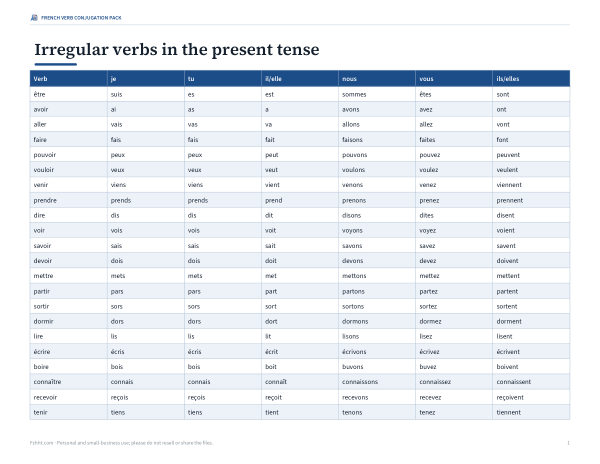 Printable French Irregular Verb Chart2 pages · free PDF
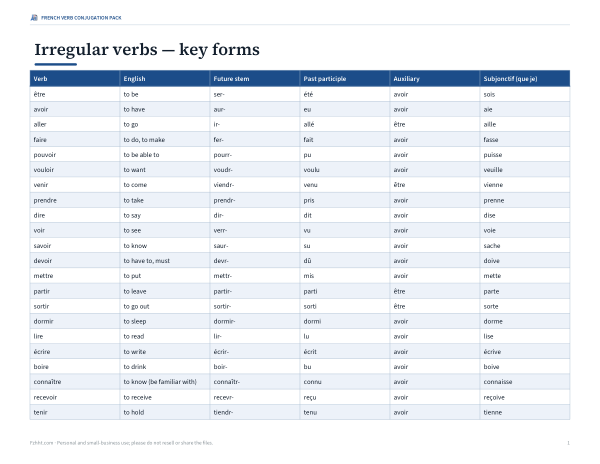 Printable French Verb Conjugation Chart2 pages · free PDF
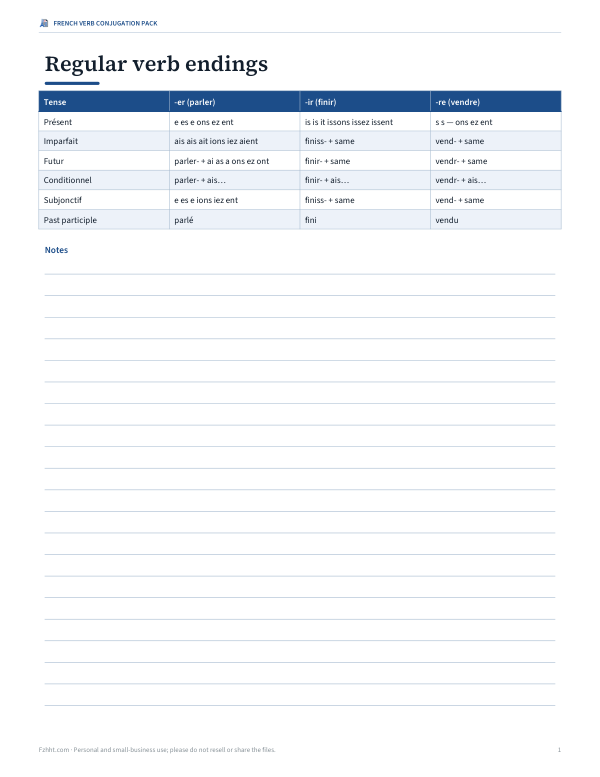 Printable French Verb Endings Chart1 page · free PDF
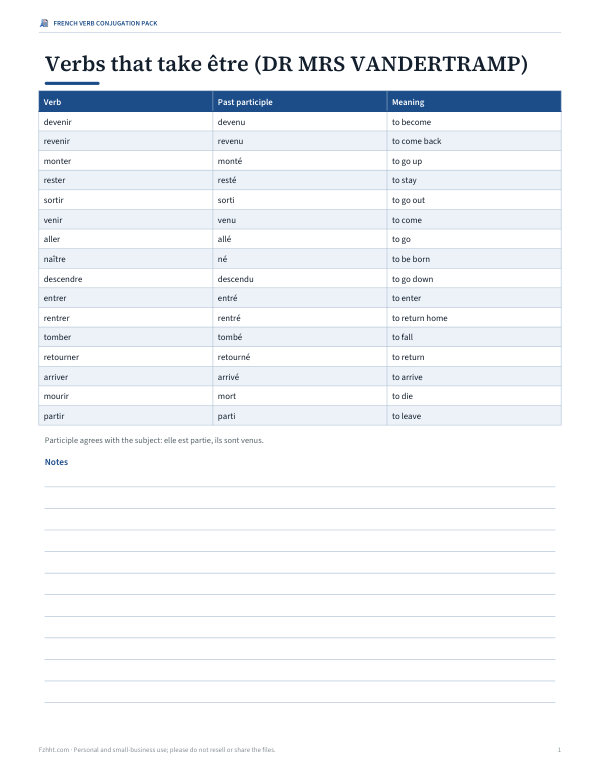 Printable Être Verb Conjugation Chart1 page · free PDF
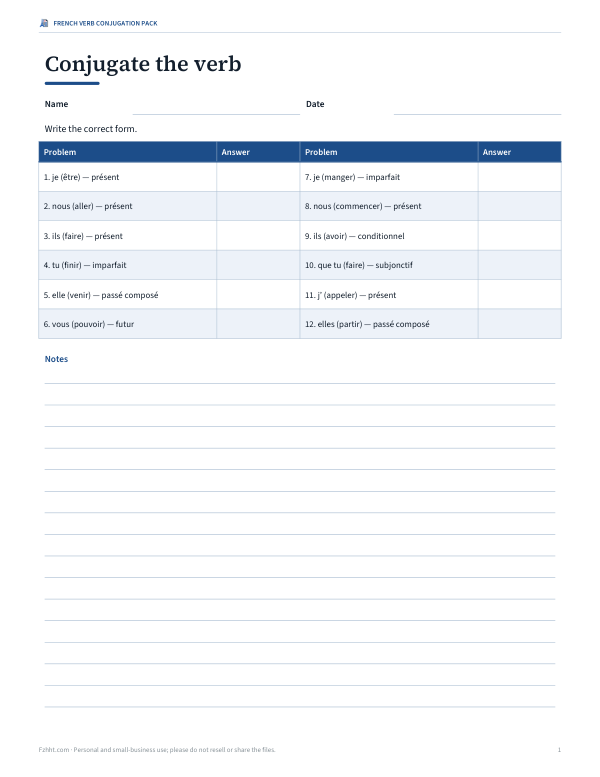 Printable French Verb Conjugation Practice2 pages · free PDF
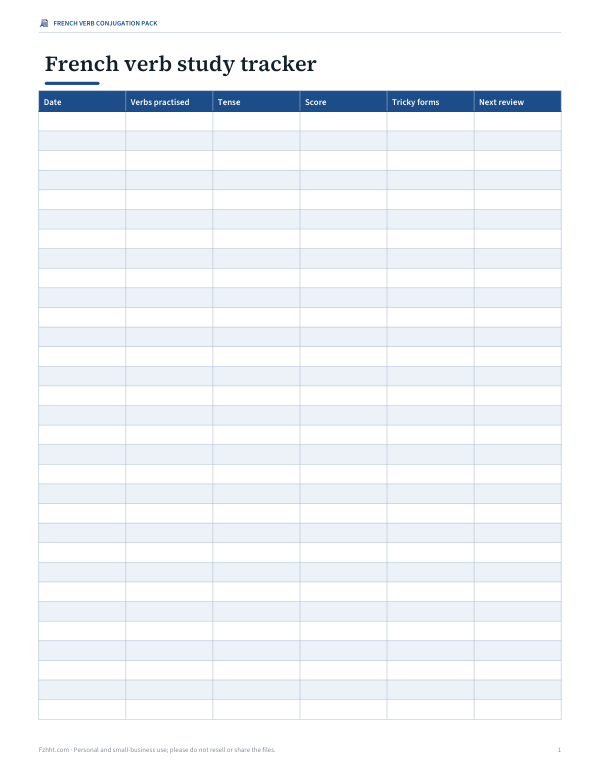 Printable French Verb Study Tracker2 pages · free PDF
The three groups of French verbs
| Group | Infinitive ending | Example | Présent endings |
|---|---|---|---|
| 1st group | -er (except aller) | parler — to speak | -e, -es, -e, -ons, -ez, -ent |
| 2nd group | -ir with -issons | finir — to finish | -is, -is, -it, -issons, -issez, -issent |
| 3rd group | irregular -ir, -re, -oir | vendre, prendre, voir | varied; many follow -s, -s, -t/-d patterns |
About 90% of French verbs belong to the first group and are completely regular apart from a few predictable spelling changes. The third group contains the most common — and most irregular — verbs, which is why learners memorise être, avoir, aller and faire first.
Tenses covered
| Tense | Use | Example (parler) |
|---|---|---|
| Présent | Now, habits, general truths | je parle |
| Passé composé | Completed past actions | j’ai parlé |
| Imparfait | Past descriptions, ongoing or repeated past actions | je parlais |
| Futur simple | Future events | je parlerai |
| Conditionnel présent | Would; polite requests; hypotheses | je parlerais |
| Subjonctif présent | After expressions of wish, doubt, emotion, necessity | que je parle |
Spelling-change verbs
- -ger verbs keep an e before -ons and -a/-o endings to keep the soft g: nous mangeons, je mangeais.
- -cer verbs use ç before a and o: nous commençons, je commençais.
- appeler, jeter double the consonant before a silent e: j’appelle, je jette, j’appellerai.
- acheter, lever, mener, peser take a grave accent before a silent e: j’achète, j’achèterai.
- préférer, espérer, répéter change é to è before silent endings in the present: je préfère, nous préférons.
- -oyer, -uyer change y to i before a silent e: je nettoie, j’essuierai.
Être or avoir in the passé composé?
Most verbs use avoir. About a dozen verbs of movement or change of state — plus all reflexive verbs — use être: aller, venir, arriver, partir, entrer, sortir, monter, descendre, naître, mourir, rester, tomber, retourner, and compounds like revenir, devenir and rentrer. Many learners remember them with the acronym DR MRS VANDERTRAMP. With être, the past participle agrees with the subject: elle est allée, ils sont partis, elles sont venues. The conjugator can show feminine agreement.
How the other tenses are formed
- Imparfait: take the nous form of the présent, remove -ons, add -ais, -ais, -ait, -ions, -iez, -aient (nous finissons → je finissais). Only être is irregular: j’étais.
- Futur simple: add -ai, -as, -a, -ons, -ez, -ont to the infinitive (drop the final e of -re verbs). Irregular verbs have special stems: ir-, ser-, aur-, fer-, pourr-, voudr-, viendr-, verr-.
- Conditionnel: the future stem plus the imparfait endings: je parlerais, j’irais.
- Subjonctif: take the ils form of the présent, remove -ent, add -e, -es, -e, -ions, -iez, -ent; nous and vous usually match the imparfait.
Worked example: finir
Finir is the model second-group verb. Présent: je finis, tu finis, il finit, nous finissons, vous finissez, ils finissent. The nous stem finiss- gives the imparfait (je finissais) and the subjonctif (que je finisse). The future uses the whole infinitive (je finirai), the conditional adds the imparfait endings (je finirais), and the passé composé is j’ai fini. Choisir, réussir, grandir and remplir follow exactly the same pattern.
Common irregular verbs to learn first
| Verb | Présent (je / nous / ils) | Why it matters |
|---|---|---|
| être | suis / sommes / sont | To be; also the auxiliary for movement verbs |
| avoir | ai / avons / ont | To have; auxiliary for most verbs |
| aller | vais / allons / vont | To go; used for the near future (je vais partir) |
| faire | fais / faisons / font | To do or make; weather (il fait beau) |
| pouvoir | peux / pouvons / peuvent | Can, to be able to |
| vouloir | veux / voulons / veulent | To want; polite requests (je voudrais) |
These six appear in almost every conversation, and many other verbs follow their patterns — prendre, apprendre and comprendre share one pattern; venir, tenir, devenir and revenir share another.
Study tips
- Learn verbs in chunks — the singular forms of -er verbs sound identical (parle, parles, parle, parlent).
- Say full sentences aloud: je finis mes devoirs.
- Practise the irregular future stems as a list; they are shared by the conditional.
- Use the quiz daily for five minutes.
- Read and listen to French: seeing verbs in context fixes them in memory.
Limits of the conjugator
The conjugator covers regular patterns, the main spelling-change groups and 30 frequent irregular verbs. French has other irregular verbs and rare forms (the passé simple, the subjonctif imparfait and compound tenses beyond the passé composé) that are not shown. Reflexive verbs (se lever) conjugate like their base verb with a reflexive pronoun and être in compound tenses. Always check unusual verbs in a dictionary.
Privacy
The conjugator runs entirely in your browser.
Frequently asked questions
How do I conjugate a regular -er verb?
Remove -er and add -e, -es, -e, -ons, -ez, -ent in the present.
Which verbs take être in the passé composé?
Verbs of movement and change of state such as aller, venir, partir, naître and mourir, plus reflexive verbs.
How is the imparfait formed?
From the nous form of the present minus -ons, plus -ais, -ais, -ait, -ions, -iez, -aient.
What is the future stem of aller?
ir- (j’irai).
Does it handle spelling changes?
Yes, for -ger, -cer, appeler/jeter, acheter-type, préférer-type and -oyer/-uyer verbs.
What is the difference between passé composé and imparfait?
Passé composé for completed actions; imparfait for descriptions, habits and ongoing past situations.
How do I say “I would like”?
Je voudrais — the conditionnel of vouloir.
Is “vous” always plural?
No, it is also the polite singular form; the verb form is the same.
What is the subjonctif used for?
After expressions of wish, doubt, emotion or necessity, such as il faut que je parte.
Is anything stored?
No, it runs in your browser.